Six years ago I tasted two red Burgundies on the same day from the same producer, same vintage, but different vineyards: 2010 Domaine Lucien Boillot et Fils Gevrey-Chambertin 1er Cru La Perrière and 2010 Domaine Lucien Boillot et Fils Gevrey-Chambertin 1er Cru Les Corbeaux. I was interested in whether I could tell the difference. And indeed, I described and rated the wines differently. I have one bottle of each left and decided to do a more rigorous experiment. Over the course of four nights I poured a tasting quantity of each wine, using a Coravin to preserve the bottle for the following night. The first two nights I was trying to train my palate on the difference and knew which wine was in each glass. The second two nights I tasted the wines blind and tried to identify which one was which.
Before I describe the results, I should point out that it the two vineyards are very close to each other. Here is a map of Gevrey-Chambertin.

It’s hard to see, but Les Corbeaux is above the M and La Perrière is below the A in CHAMBERTIN. Still, I had high hopes that I would be able to detect a difference.
The first night I wrote that the Perrière had “more fruit and flowers on the nose,” whereas the Corbeaux had “more funk and earth.” On the second night I reversed this description, so I decided that it might make more sense to go by the palate. I wrote that I was getting a “salty note from the Corbeaux and lemony acids from the Perriere.” There was also something hair raising about the aroma of the Corbeaux. On the third night, tasting blind, I used the salty note palate as the criterion, and got the answer wrong. So apparently the palate was just as changeable as the nose. On the fourth night I decided simply to go with the wine that I liked better. In 2014 I gave the Perrières 93 and the Corbeaux a 95, and in 2020 the scores were 92 and 94, and I had noted that emotional charge in the aroma of the Corbeaux. There was certainly one wine that I liked better on the fourth night. It turned out to be the Perrières.
My conclusion is that there is no difference discernable by me in these wines. This is not surprising given the proximity of the vineyards, but I do not rule out that someone with a finer sensitivity could consistently distinguish them.
Another, perhaps more interesting, observation is that my brain, being told that the two wines were different, worked hard to come up with differences. Given a complex mix of aromas and flavors, it picked different components of the mix to distinguish the two and gravitated successive sips in the course of one night towards those components. But it came up with different components on different nights. I think this a great illustration of the importance of blind tasting.
On a final note, I just got an email announcing availability of the 2017 Chevillon Nuits-Saint-Georges, which included the following helpful map.
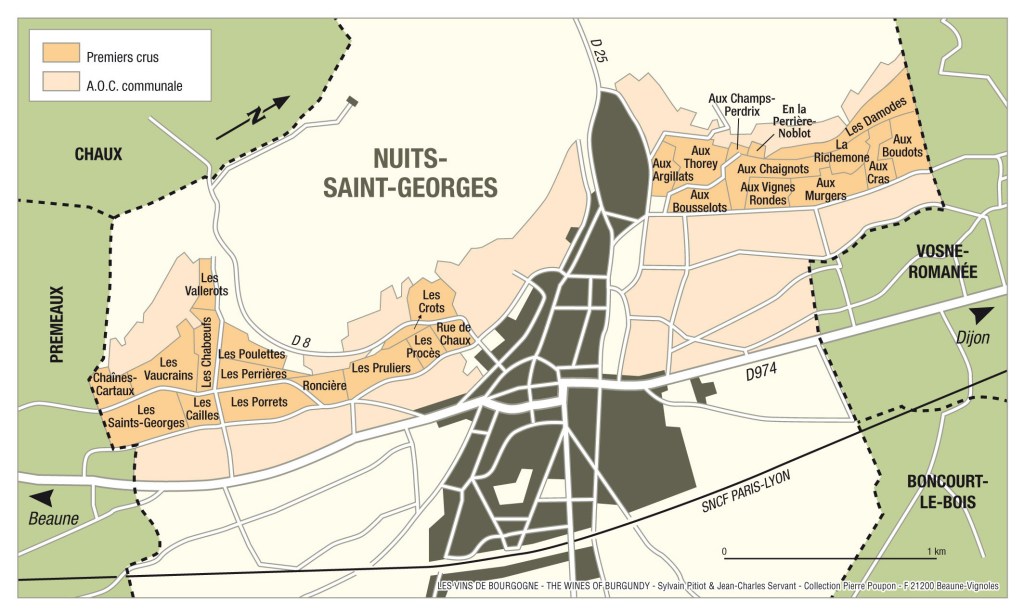
Note the positioning of Les Perrières relative to Les Cailles, diagonally on a crossroads to the left of the map. Les Cailles is almost 50% more expensive than Les Perrières.
 Wine Experiments
Scientifically interesting! And those maps showing miniscule vineyards reminded me again of that old chestnut, Roald Dahl’s story “Taste.” https://www.hffmcsd.org/site/handlers/filedownload.ashx?moduleinstanceid=281&dataid=1201&FileName=taste.pdf
LikeLike
Lovely story, I didn’t know it. I just learned from reading the biography of Elizabeth David, Writing at the Kitchen Table, that Roald Dahl was a friend of hers. She abhorred the sort of pretension portrayed here.
LikeLike
Pingback: Terroir experiment no. 2 | Wine Experiments