As a reminder, I am working on the hypothesis that the main effect of allowing wine to breathe is a slight loss of complexity in the nose. I’ll relieve the suspense and say right now that this experiment confirmed the hypothesis (as did experiments nos. 2 and 3, at least as far as my own perceptions go).
This experiment was conducted 20 May 2017. I used a wine that is often said to benefit from air, a red burgundy. The methodology was the same as experiment number 3. The wine breathed for 3.5 hours, whereas in previous experiments it has been more like 6. (I realize I should be recording these numbers.)
My three glasses had wine from the decanter, decanter, and bottle, respectively. Here are my notes (written before the reveal):
ddb at first because the right one seemed bit funky on the nose
second thoughts the middle seems slightly spicier, so maybe dbd
right one seems to have a fruitier palate
no difference in tannins or acidsleft two more floral on the nose
going with first instinct
This result is consistent with my theory that breathing causes the nose to lose complexity, although in this case some might find the unmasked floral character of the decanted wine more appealing. It is also consistent with the observation that the effect is quite small; note the uncertainty and wavering.
By the way, my friend and colleague Phil Daro sent me a link to this blog post, which in turn has a link to this 1999 article from the New York Times. Reading them almost made me think I don’t need to bother with any more breathing experiments. They confirm my preconceptions. Except Science! Let’s go from preconceptions to statistical evidence. It will take a lot of breathing experiments to do that. The things I do for Science.

Interesting addendum: my daughter wandered in about an hour after the bottle had been opened, and wanted to try the experiment. She identified the configuration correctly (dbd). Her reasons were entirely from the nose: she thought the middle wine had an aroma that was more mushroomy and gamey, whereas the other two she said were more metallic. Possibly my “funky” had evolved into her “mushroomy and gamey” in one hour. Maybe I need to do an experiment with multiple decanting periods.
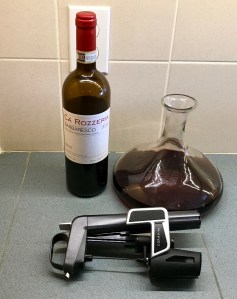 This was my first breathing experiment using the Coravin, on May 4, 2017. The methodology is the same as before, except that it uses one bottle instead of two. I poured half the bottle into a decanter 6 hours in advance using the Coravin, and left the other half corked under its blanket of argon. I used a
 Wine Experiments