Setting up some long term experiments

IMG_0287

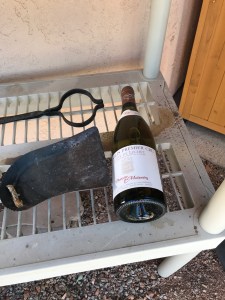
First, on April 15, 2017 I put a bottle of Chablis outside my treehouse. It is in the shade but will experience the full summer heat otherwise. I will compare it with a bottle of the same wine from inside the treehouse some time in the fall. (The treehouse is my temperature-controlled storage facility.)

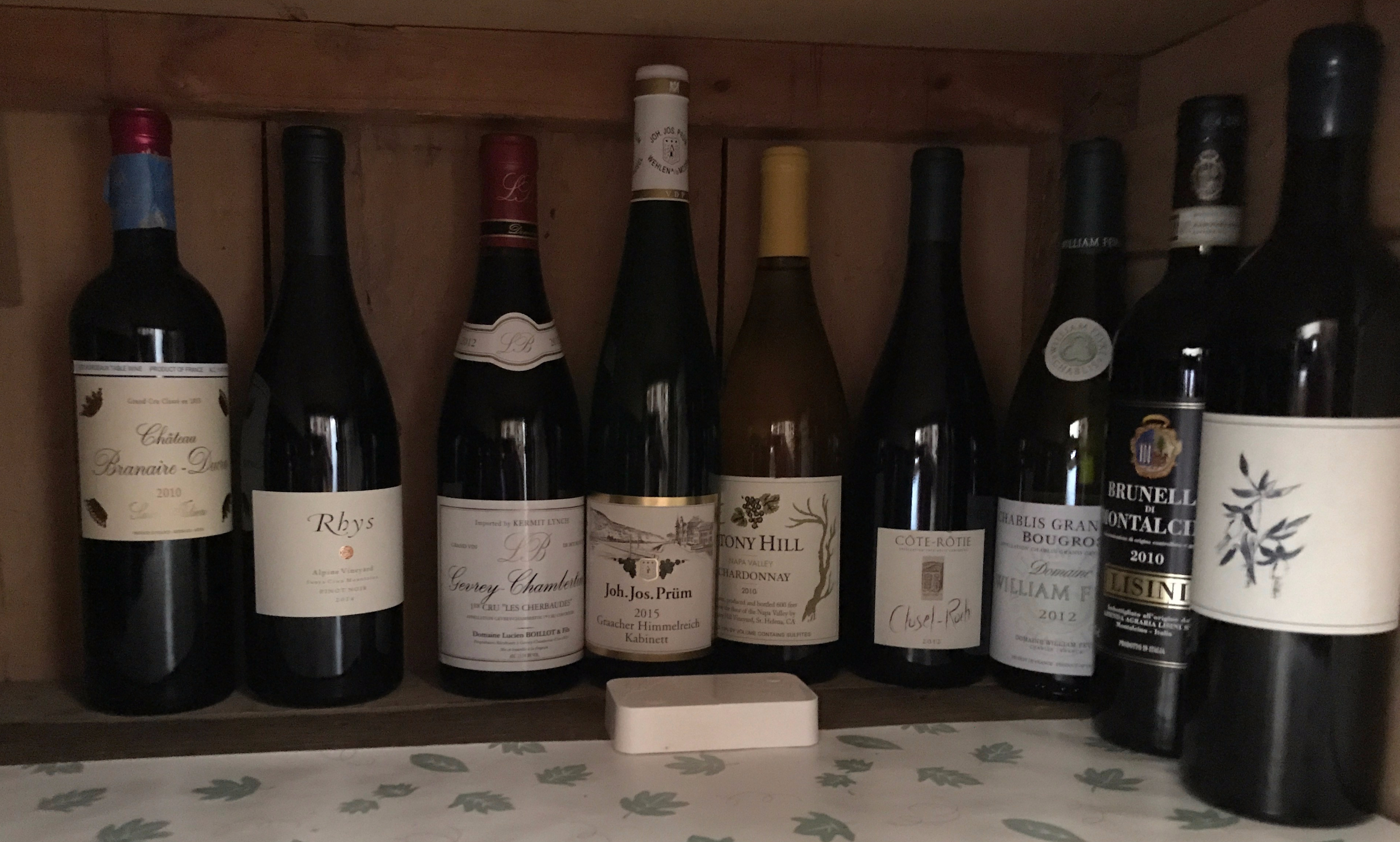
Second, on April 23, 2017 I moved 9 bottles from the treehouse to a cupboard in my wine room inside the house. I have more than one of all these wines, so each has a companion in the treehouse. The wine room can get close to 80º F in the summer, compared with 60º F in the treehouse.  I will monitor the temperature and humidity in both places and do a comparison every so often over the next 10 years or so.
img_0289.jpg

After taking this photograph I put all the wines into a horizontal position, the same as the wines in the treehouse. The complete list is:

2013 Arnot-Roberts Cabernet Sauvignon Fellom Ranch
2012 Domaine Lucien Boillot et Fils Gevrey-Chambertin 1er Cru Cherbaudes
2010 Château Branaire-Ducru
2012 Clusel-Roch Côte-Rôtie
2012 Domaine William Fèvre Chablis Grand Cru Bougros
2010 Lisini Brunello di Montalcino
2015 Joh. Jos. Prüm Graacher Himmelreich Riesling Kabinett
2014 Rhys Pinot Noir Alpine Vineyard
2010 Stony Hill Chardonnay
Breathing experiment no. 2

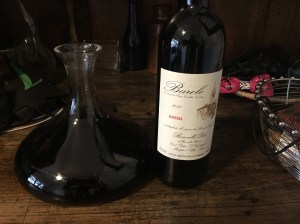
It was to be over a year before my second breathing experiment. This time I used an inexpensive (but absolutely delicious) Spanish garnacha, and conducted the experiment with my wife, my daughter, and her boyfriend. The methodology was the same as described in the previous post. I asked people not only to choose the odd wine out, but also to identify whether it was from the bottle or the decanter. Here were the results:

Person Configuration Choice Identification
A bbd 1 b
H bdd 3 b
B bbd 3 d
S dbd 3 b

Once again I was the only person to choose correctly, and, unlike the last time, I correctly identified the source as well. It would be strange if this trend continued; random guessing would lead to one third the people getting it right in the long run. But it is too early to make a big deal about it. Here are my notes:

Aroma on 3 seemed slightly faded. Palate indistinguishable.

This experiment confirms my hypothesis that one effect of breathing is decreased complexity in the nose.

One thing I worry about is that bottle variation can confound the results of these experiments. So after this experiment I purchased a Coravin™ (for Science!) and will use it next time to decant half of one bottle. Stay tuned.

Does wine breathe?

It is commonly believed that you should let some wines breathe by opening them a few hours before drinking them, possibly decanting them as well. My first experiment to test this hypothesis was on Christmas Day 2014, with two bottles of 2001 Château le Meynieu.  I decanted one bottle for 3 hours and then opened a second bottle just before a blind comparison of the two, along with some of our dinner guests. There was very little discernible difference. I imagined one had a little more fruit on the palate, and that turned out to be the one that had just been opened. But I wasn’t sure of any real difference between them.

IMG_6056I wasn’t very satisfied with the experiment for a couple of reasons. For one thing, the wine was pretty ordinary, and for another, everybody knew they were different and was looking for it. So the following Thanksgiving Day, 2015, I chose a Barolo, a wine which people often say needs to breathe, and I used the Sesame Street method: each person was given three glasses and had to pick the one that was not like the others. One bottle was decanted 6 hours in advance, the other opened immediately beforehand. One guest served as a lab assistant, and, in another room, randomly chose and poured one of 6 possible configurations for each guest: ddb, dbd, bdd, bbd, bdb, dbb (where b = bottle and d = decanter). Nobody knew which position the odd glass out was in or whether it came from the bottle or the decanter, and each person had an independently and randomly chosen configuration. Here were the results
Person Configuration Choice
B dbb 1
D dbd 3
R bbd 2
A dbb 3
R&P dbb 2
J ddb 2

Only one person correctly picked the odd glass out, and, as it turns out, that person was me. Here are my notes from that occasion:

I had a feeling one of the three was more aromatic and spicier, more tannic on the palate, whereas the other two had a richer flavor on the palate. I was not at all sure it wasn’t my imagination, however. As it turns out, I correctly picked the glass that was not like the other two, but mis-identified it coming from freshly opened bottle rather than the decanter.

The reason I identified the odd wine out as coming from the freshly opened bottle was a hypothesis that the mostly like effect of breathing was to dispel some of the more volatile components in the aroma. Clearly more research was needed. I didn’t do my next breathing experiment until a few weeks ago, which I will describe in next week’s post.

My first wine experiment

I started collecting wine seriously in 2012. Apart from enjoying the wine, I am interested in finding out for myself whether the things people say about wine—that it ages, that you should let it breathe, that you must keep it at a certain temperature—are true. Over the last few years I have conducted various experiments to find out. Here I will describe my very first experiment, conducted in the summer of 2014.

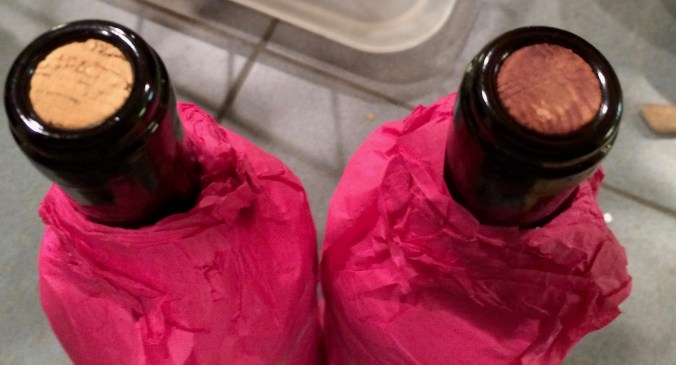
In 2014, I left a bottle of 2012 Cascina Chicco Barbera d’Alba Granera Alta out in the Arizona heat all summer (100º–110º F). I had another bottle of the same wine in my temperature controlled storage facility (about 60º F). In November I did a blind tasting with my wife and another couple. The abused bottle had a wrinkled label, so I wrapped the bottles in pink tissue paper; once the corks were removed you couldn’t tell the difference. (In the photo the abused bottle is on the right.) Since I was the one who removed the corks I asked my wife to go into another room and, on the toss of a coin, either swap the bottles or not. Each guest had two glasses and was served from the two bottles in the same order.

Amazingly, the wine left out in the sun was drinkable. One of my guests could not tell the difference between it and the properly stored wine, and all agreed that the difference was subtle. I found that the abused wine was fruitier and lacking in acid, with harsher tannins, and a spicier aroma. The properly stored wine had more structure. It also had a slightly funky mulchy element to the nose. It was a much better food wine because of the acid; the abused wine was insipid during the meal. But it was quite drinkable, and preferred by two of my guests who like a softer style of wine.

20141116-IMG_4637

This summer I am conducting the same experiment with a white burgundy, which I will write up in the fall.