Terroir experiment no. 2

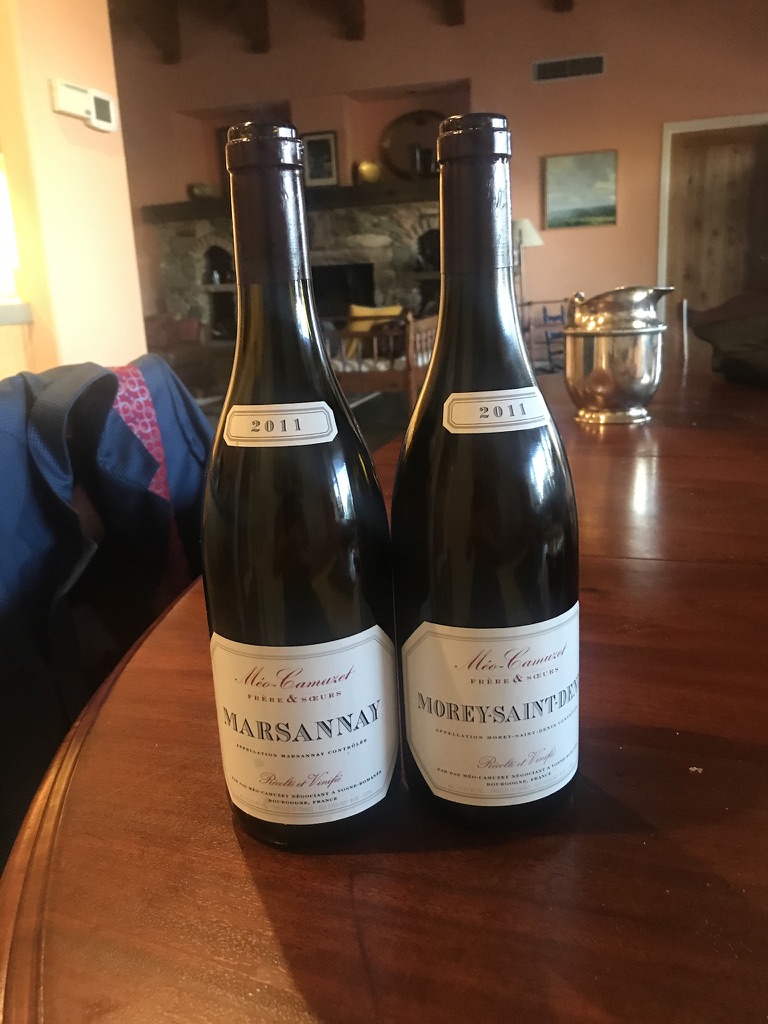
This time I compared two village level red burgundies from different villages, both 2011 Méo-Camuzet, one from Marsannay and one from Morey-Saint-Denis. The grapes for a village level wine must all come from designated vineyards in that village, but don’t necessarily come from a single vineyard. Single vineyard wines from Premier Cru or Grand Cru vineyards get an additional vineyard designation. The classification of vineyards was made in 1861!

Both villages are in the Côte de Nuits, shown in green in the map on the left and expanded on the right. Marsannay is at the northern end and More-Saint-Denis is halfway down, about 10 km south of Marsannay.

Map of Côte de Nuits, from Wikipedia, released under a CC BY-SA 4.0 license

I followed the same protocol as in my previous terroir experiment, giving myself two nights training followed by four nights of blind tasting. Since I had so much trouble with the nose last time I focused on the palate, and after two nights had formed a definite opinion about the difference, detectable on the very back of the palate, just before swallowing. The Morey-Saint-Denis had more dark fruit and tannin on the back end, whereas the Marsannay had more of an aromatic sour cherry character. On the second night I also detected after 20 minutes a slightly bruised plummy note on the nose of the Marsannay, but was not planning to use that.

On the first night of blind tasting I was sure of the difference on the first stip. I identified the back palate character described above for each wine. I took a few mores sips, each one confirming the last. I became quite sure and turned the bottles around. I was right.

The second and third nights did not go so well. On the second night I caught a whiff from one of the wines that made me think it was the Marsannay, not the aroma noted above, but a bright red fruit aroma. At first I thought the back palate confirmed this, then I started having trouble distinguishing using that criterion. I eventually went with my original impression and was wrong. On the third night I had trouble separating the wines at all, after a long drive home from Scottsdale, and guessed wrong again.

I almost gave up at that point, but decided to have one more try, this time as I was starting dinner after having had a couple of pre-dinner drinks. I immediately caught the plummy aroma from one of the wines, unmistakably the same as four nights ago. I was still having trouble on the back palate, but went with the identification of that wine as the Marsannay, and I was right.

What is to be made of this? The times when I was sure of the difference I was right, but I wasn’t always sure of the difference. When I was sure it was because I clearly recognized a characteristic noted (and written down contemporaneously) during the training phase. I’ll take this as evidence that the wines have different character detectable by humans; whether it is terroir is another matter. As is what that term even means!

Terroir experiment no. 1

Six years ago I tasted two red Burgundies on the same day from the same producer, same vintage, but different vineyards: 2010 Domaine Lucien Boillot et Fils Gevrey-Chambertin 1er Cru La Perrière and 2010 Domaine Lucien Boillot et Fils Gevrey-Chambertin 1er Cru Les Corbeaux. I was interested in whether I could tell the difference. And indeed, I described and rated the wines differently. I have one bottle of each left and decided to do a more rigorous experiment. Over the course of four nights I poured a tasting quantity of each wine, using a Coravin to preserve the bottle for the following night. The first two nights I was trying to train my palate on the difference and knew which wine was in each glass. The second two nights I tasted the wines blind and tried to identify which one was which.

Before I describe the results, I should point out that it the two vineyards are very close to each other. Here is a map of Gevrey-Chambertin.

https://thevinofiles.typepad.com/the_vino_files/2008/09/gevrey-chambert.html

It’s hard to see, but Les Corbeaux is above the M and La Perrière is below the A in CHAMBERTIN. Still, I had high hopes that I would be able to detect a difference.

The first night I wrote that the Perrière had “more fruit and flowers on the nose,” whereas the Corbeaux had “more funk and earth.” On the second night I reversed this description, so I decided that it might make more sense to go by the palate. I wrote that I was getting a “salty note from the Corbeaux and lemony acids from the Perriere.” There was also something hair raising about the aroma of the Corbeaux. On the third night, tasting blind, I used the salty note palate as the criterion, and got the answer wrong. So apparently the palate was just as changeable as the nose. On the fourth night I decided simply to go with the wine that I liked better. In 2014 I gave the Perrières 93 and the Corbeaux a 95, and in 2020 the scores were 92 and 94, and I had noted that emotional charge in the aroma of the Corbeaux. There was certainly one wine that I liked better on the fourth night. It turned out to be the Perrières.

My conclusion is that there is no difference discernable by me in these wines. This is not surprising given the proximity of the vineyards, but I do not rule out that someone with a finer sensitivity could consistently distinguish them.

Another, perhaps more interesting, observation is that my brain, being told that the two wines were different, worked hard to come up with differences. Given a complex mix of aromas and flavors, it picked different components of the mix to distinguish the two and gravitated successive sips in the course of one night towards those components. But it came up with different components on different nights. I think this a great illustration of the importance of blind tasting.

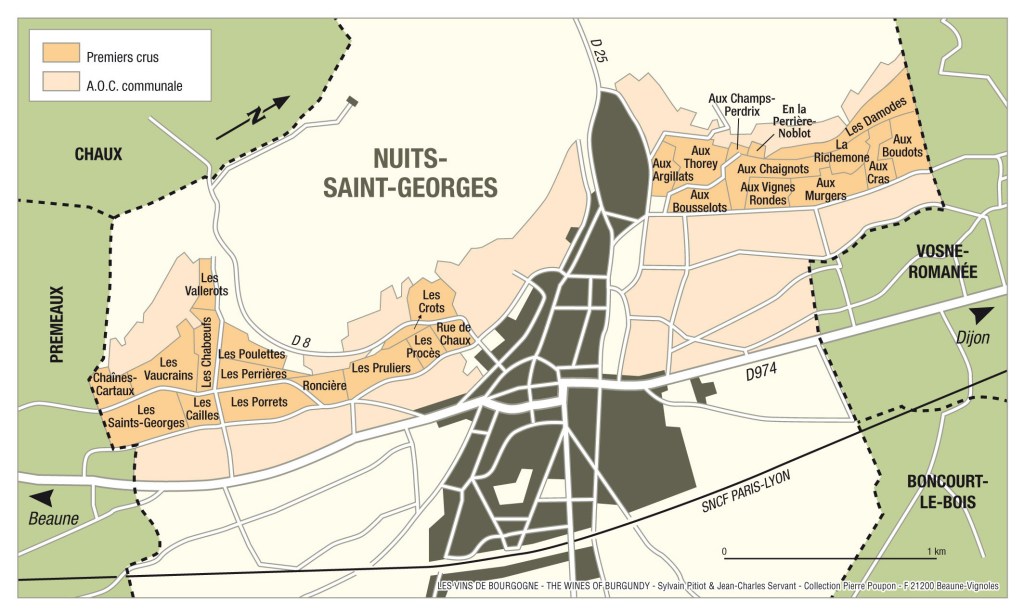
On a final note, I just got an email announcing availability of the 2017 Chevillon Nuits-Saint-Georges, which included the following helpful map.

Note the positioning of Les Perrières relative to Les Cailles, diagonally on a crossroads to the left of the map. Les Cailles is almost 50% more expensive than Les Perrières.

Aging experiment no. 2

label

I did this experiment back in August of 2019, but left soon after for Italy to be with Amy and didn’t get around to writing it up until now. The wine was a 2012 Clusel-Roch Côte-Rôtie. One bottle had been sitting in my  house since April 2017, with temperatures ranging from 58º to 84º, with an average of 73º. The other had been in my temperature controlled cellar, at temperatures ranging from 49º to 60º, with an average of 58º. Although I’m not convinced humidity is as important as people say it is, I note also a significant difference in average humidity: 52% in the cellar versus 13% in the house.

We followed the usual protocol. Here are the results showing each person’s guess at the odd one out, and their guess at the source if they made one (H=house, C=cellar):

GuessSourceTruth
Bill1CellarHCH
Sally3CellarHCH
Amy3HouseCHH
Housten1CellarCHH
Rob2HHC
Penny3CCH

Two people guessed correctly, and one of them, Housten, correctly identified the source. He said that number 1, from the cellar,  was “brighter.” Penny, who did not make a guess as to the source, said that number 3, from the house, was “sharper and more acidic.”

Of course, 2 out of 6 is exactly the probability of getting the answer correct if you guess randomly. As with my previous aging experiment, the evidence so far in favor of temperature controlled storage is weak. But it’s only been 2 years. I have 7 more years to go.

Here is my tasting note on the wine.

Aging experiment no. 1

Eight months ago I brought some wines into the house to see if the higher temperatures there had a discernible effect on aging. Yesterday for Thanksgiving we had our first experiment with the 2014 Rhys Pinot Noir Alpine Vineyard. We compared the bottle from inside the house with the bottle from the cellar using the usual protocol. Nine guests participated, four pairs sharing the same set of glasses. Each person in a pair was allowed to guess independently.  One person correctly chose the bottle that was different from the others but misidentified the source; nobody else correctly identified the bottle. I would have correctly identified both the bottle and the source if I had stuck with my original impression, but I was talked out of it by my partner. Probably the cross talk between pairs had an effect, so it might be cleaner to have everybody with their own set in the future.

Here is a graph of the temperature difference between the two locations over the last 18 months. The red line is the inside room, the green line the cellar (blue is humidity inside).

Screen Shot 2018-11-23 at 3.58.41 PM.png

We’ll do this again next year!

Discrimination experiment no. 3

Sally, Housten and I tasted an Australian cabernet for this experiment. Usual protocol: half the bottle in a decanter for 3 hours, half under argon gas in the bottle, each person presented with two glasses in random order. I explained that we were looking for the wine that had fewer primary and tertiary aromas and more fruit aromas, and that that wine should be the decanted one. All three of us got it right, and all three of us thought the difference was marked. There was some confusion initially about the instructions: Housten asked if the wine from the bottle should have a more complex aroma (I said yes) and Sally initially got the wines the wrong way around, but her description fit the correct identification. That is, she said the fruitier one was from the bottle.

This and the previous experiment stimulate a couple of thoughts. First, in the previous experiment we were drinking out of glasses that were not ideal for detecting aromas; they were too small so it was hard to swirl and release the aromas into the glass. Second, the instructions are clearly confusing. So for future experiments I should probably stick to my standard wine glasses. And I think I’ll dispense with the long complicated description and just ask two questions: which wine is fruitier and which wine has a more complex aroma? Then correlate the answers with the source.

Here is my tasting note on the wine.

Speaking of wine glasses, maybe that’s another experiment. Riedel has 14 variety-specific glasses in the Vinum series. I chose the Riesling/Zinfandel glass as my all-purpose glass on the recommendation of Making Sense of Wine, by Matt Kramer. It has the right size and shape to swirl and sniff without being absurdly bloated. I’ve always assumed that the classification of glass shapes was a bit like the proliferation of tartans in the 19th century; a fiction designed to sell more glasses (or wool). But I do happen to have some absurdly bloated chardonnay glasses that were sent me by mistake once. Not sure exactly how to manage a blind experiment here; get someone else to hold the glass?

I’m heading off to Italy for a month on Friday, and I don’t think it’s likely they will allow Coravin capsules on the plane, so this blog might become a little sporadic. I suppose I could run experiments comparing a decanter with an open bottle.

Discrimination experiment no. 2

Interesting dinner party with a group of friends. I brought this cru bourgeois Bordeaux, half of which had been decanted 3 hours earlier. We followed the protocol described in the previous discrimination experiment. I described the difference we were looking for in terms of primary versus secondary and tertiary aromas. Of the 7 participants, only one correctly identified the source of the wines. (It was not me.) Now, people’s reasons for their choices did not always follow the description I had given at the beginning; many described one wine as having more complex aromas than the other (that was identified in these cases as the wine from the bottle); some made reference to the acidity. So, maybe there was a flaw in the instructions. Me, I found it very hard to distinguish between the two. None of the people in the group was a self-professed connoisseur.

So, good addition to the data set. I think we need a larger N size.

Discrimination experiment no. 1

This is a new series of experiments following the protocol outlined in my last post. It involves just two glasses, and the test to see if the presence of secondary and tertiary aromas discriminates between the bottle and decanter. For the first experiment in this series I used an inexpensive Bordeaux. Here are my notes, written before the reveal:

On the left, fine spicy cedar notes and good fruit. On the right, a slightly funky mushroom overtone. So the one on the right is the bottle.

I was right. And tasting after the reveal, I thought the tannins on the decanted palate were mollified by the soft fruit. Perhaps this is behind the notes you sometimes read saying that the tannins softened with air. I’ve never believed it possible that the tannin composition changes chemically over such a short time, but possibly the revealed fruit aromas create a perception of softening.

I found the difference quite decisive. In previous breathing experiments the difference often seemed very subtle. Maybe formulating a hypothesis sharpens the mind’s attention in a way not present when you are simply trying to decide if there is any difference at all.

Here is my tasting note on the wine.

Analysis of breathing experiment statistics

After 10 breathing experiments I decided to run some numbers on the results. The raw data is here. I don’t know how a statistician would handle inferences from this data, but I can calculate probabilities for a binomial distribution. The fundamental question was whether there was a detectable difference between wine that had been allowed to sit in a decanter for a few hours (typically 3–6) and wine from the same bottle that had sat under cork and argon gas (or from a different bottle of the same wine in earlier experiments). Subjects were presented with three glasses and had to pick the one that was not like the others, following this protocol. Here are the statistics for the whole group, and for me alone. The last column is the probability of doing as well or better by chance alone (assuming a 1/3 chance of a correct guess in each trial).

Group No. of trials No. correct
Probability 
Everyone 30 16 0.02
Me 10 7 0.02

I am sufficiently convinced by this that there is a difference detectable by humans. But feel free to check the data and disagree in the comments.

I also ran the conditional probabilities on correctly identifying the source of the wine given that you had correctly picked the odd one out.

Group No. of trials No. correct Probability
Everyone 16 10 0.22
Me 7 5 0.23

This is less convincing, although of course the sample size is smaller. But it suggests to me the next series of experiments. Having established that decanting makes a small but detectable difference, the next question is: what is the difference? Reading over my notes, I think it is reasonable to make a hypothesis in terms of primary, secondary, and tertiary aromas. There’s a nice description these at Wine Folly. Primary aromas are the aromas coming from the grape itself (fruit, flowers, herbs). Secondary aromas come from the fermentation process (yeast, cream, lees, mushroom, and Brettanomyces aromas such as barnyard, game, and bacon) and tertiary aromas come from the aging process, particularly from aging in oak barrels (vanilla, nuts, baking spices, cedar, smoke, tobacco, leaves). We will adopt the terminology from Wine Folly: “aroma” means the primary aromas, and “bouquet” means the secondary and tertiary aromas.

The hypothesis we will work with in this series of experiments is:

Wine from a freshly opened bottle has a stronger bouquet, which tends to mask the aroma. The aroma is more prominent in wine from the decanter.

I’ll use a new experimental protocol. The question is no longer whether there is a difference, but whether a particular description of the difference is accurate and usable by humans. I’ll present subjects with two glasses blind, one from the bottle and one from the decanter, ask them to read the description of aromas above, and then ask them to apply the hypothesis to identify which is which.

I will also collect data on preference, and for that reason I will organize the experiments by varietal, starting with Bordeaux varietals and blends. Then I will move onto pinot noir. The conventional wisdom is that breathing is good for the former and not for the latter. The breathing experiments so far somewhat support this.

Breathing experiment no. 10

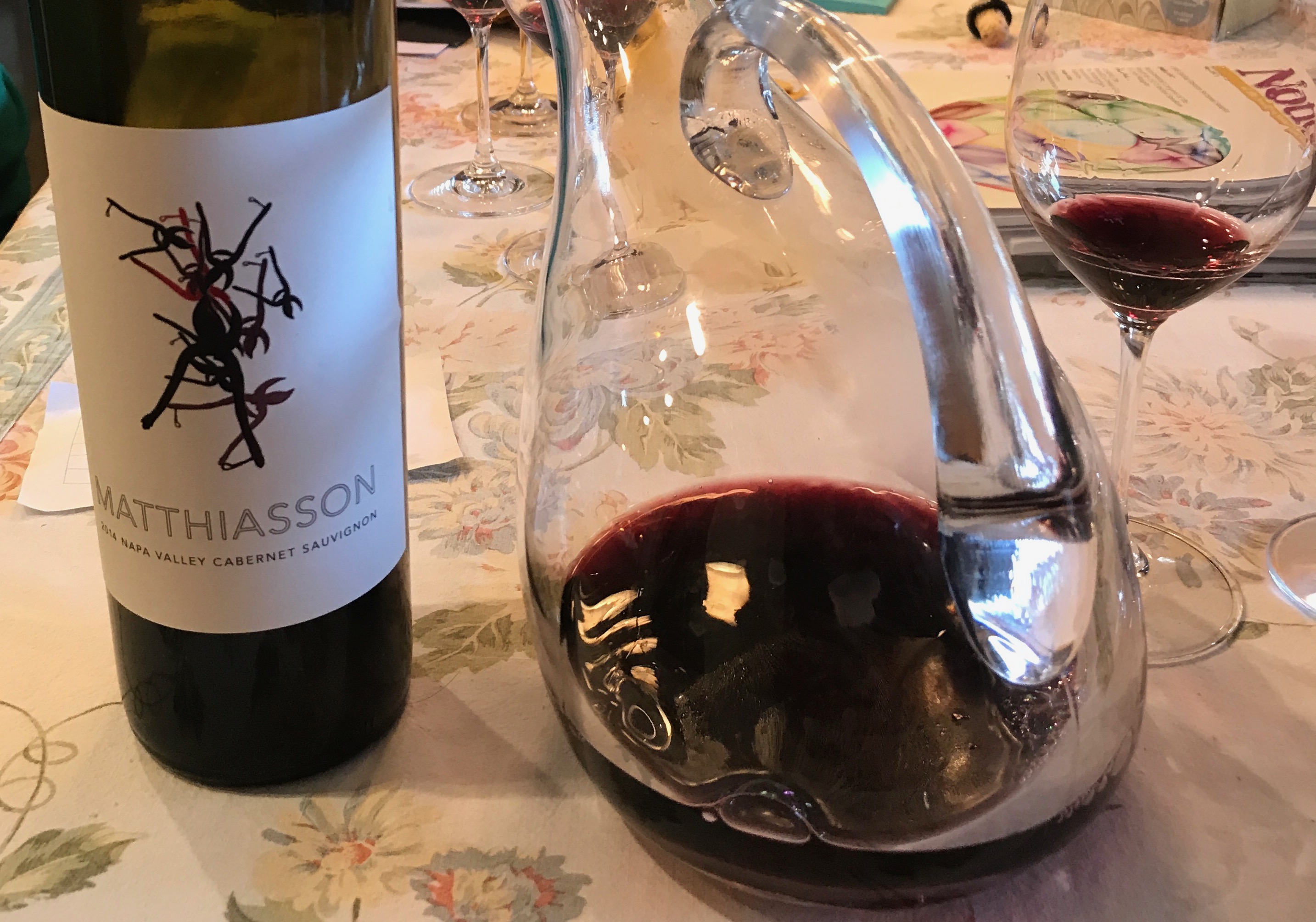
This time I chose the 2014 Matthiasson Napa Valley Cabernet Sauvignon. Matthiasson makes wonderful wines that blend the vividness of California with the structure and balance of France. (Jason, photo of label below.) But I digress. Usual protocol. My notes:

First impression: first one is more floral and fruitier, second two more masked with a cedary spicy note, so dbb. No discernible difference on the palate. In this case the masking note is quite nice. At one point I almost wanted to reverse the classification of the first and third bottles, for bbd. But I started to get confused, so went with my first impression, even though it has failed me the last couple of times.

Failed me again: the correct configuration was my second guess, bbd. I seem to be having trouble second guessing whether I should second guess. Still, either way, the thing I thought I was detecting—the presence or absence of a masking note—is consistent with previous breathing experiments with cabernet and Bordeaux blends. So I think there’s something in that hypothesis, and maybe I should try to design an experiment to test it explicitly. Perhaps a very long decant to emphasize the difference.

John Gilman’s often talks about a top note of bla bla bla. I think I’m beginning to understand that, and used the phrase in my tasting note for this wine.

IMG_1528

Consistency of tasting notes across time

Not so much an experiment this morning as a collection of raw data. I was struck by the consistency of this sequence of three of my tasting notes over a three-year period, so I decided to examine other sequences. I have too many sequences of three to handle without some serious data-mining, but here is a list of all the sequences of four or more, excluding sequences that included an un-rated or flawed wine or a note written from memory.

2000 Il Marroneto Brunello di Montalcino

2008 Domaine de Terrebrune Bandol

2012 Jamsheed Syrah Beechworth

2012 Jauma Syrah Scyras Clarendon Vineyard

2013 Denis Jamain Reuilly

2014 Jean-Louis Dutraive (Domaine de la Grand’Cour) Fleurie Chapelle des Bois

2004 Château Bernateau

2010 Château Haut-La Pereyre

1998 Pertinace (Cantina Vignaioli) Barbaresco Vigneto Castellizzano

It’s a mixed bag. I don’t really have time to go through them all (have to get on a plane this morning), nor do I have the tools to analyze them in a rigorous way. The 1998 Barbaresco shows wide variation, which is reflected in the other notes, and it seems reasonable to suppose that it was undergoing change. Others are very consistent, for example the 2014 Fleurie. I have to run now, but will examine these further and perhaps add some thoughts in the comments section. I should note that I never look at previous notes on a wine before writing a new one, and I don’t remember much from tasting to tasting, so these are largely independent notes.