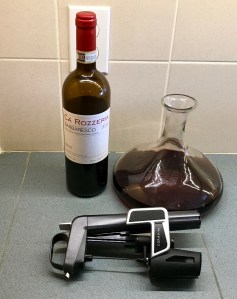
Breathing experiment no. 9: short decant

Following on my last Bordeaux experiment I tried a short one-hour decant of a classically styled California cabernet. Usual protocol. My notes (as always, written before the reveal):

First impression, more fruit on no. 1, more stemmy notes on the others. This  difference fades almost immediately. I began to think no. 3 was more like no. 1 after a while, but will go with first impressions again. Based on previous observations, no. 1 would be the decanter.

Well, if I had changed my mind on no. 3 I would have gotten it right; my configuration was dbd. The note on no. 1 is consistent with observations in previous Cabernet or Bordeaux experiments, that the fruit comes out a little more after a decant, or rather that the stemmy mask drops away. But the difference was very slight; it’s hard to be confident that the guesses were anything other than guesses here.

What is the difference between Côte de Beaune and Côte de Nuits?

The Côte d’Or is a ridge of limestone in Burgundy, divided into the Côte de Nuits in the north and the Côte de Beaune in the south. It’s where the most famous red burgundies come from, with the famousest (and most expensive) coming from the Côte de Nuits. Here is a typical description of the difference between the two:

The top reds from the Côte de Nuits . . . often have greater intensity and a firmer structure than red wines from the Côte de Beaune . . . . By contrast, the top Côte de Beaune reds are frequently softer and sometimes more lush. In general, reds from all over the Côte d’Or are prized for their soaring, earthy flavors, often laced with minerals, exotic spices, licorice, or truffles.

—Karen MacNeil, The Wine Bible

In the last five years I have written 1030 tasting notes on CellarTracker, 41 on red wines from the Côte de Beaune and 34 on red wines from the Côte de Nuits (as of this writing; there will probably be more by the time this post is published). So I thought I’d do a text analysis to see if my notes reflect the difference described above. I used this online utility to create a word frequency list for each set of tasting notes. From that I created a list of descriptors. This included most words that refer to the aroma, flavor, or position on the palate. Some words were problematic: for example, the word “tannin” might be modified by “strong” or “weak,” but that information is lost in the frequency count. So I eliminated words related to strength of aroma, tannin, acid, fruit, or finish. It will take a later analysis to detect differences there. I also consolidated some terms—for example forest floor, stems, stemmy, heath, brambles, bracken, leaves, undergrowth—where I thought the distinction was likely to be noise.

Finally, I computed a CDB index for each descriptor: the frequency of a descriptor per tasting note for Côte de Beaune divided by the sum of the frequencies for Côte de Beaune and Côte de Nuits. Descriptors in the first section in the table below, with CDB index less than a third, are more than twice as likely to occur in a Côte de Nuits tasting note than in a Côte de Beaune, and it’s the other way around for descriptors in the third section. The descriptors in the middle section apply pretty well equally to all wines in the Côte d’Or.

So, to take a bit of poetic license with the table, red wines from the Côte d’Or in general are complex, with aromas of berry, violet, smoke, and undergrowth, and a nice spread of fruit on the palate with a focused core and crackling acids (well, “spread” and “focused core” are contradictory, so really it’s either/or there). Red wines from the Côte de Nuits are austere, elegant, and balanced, with shy flavors of strawberry, raspberry, blackcurrant, black cherry, earth, mocha, and thyme, whereas red wines from the Côte de Beaune are rich and soft with penetrating jammy fruit and crusty aromas of mushroom, leather, and sweet spice.

How much of this do I believe? Well, taking the flavor descriptors with a grain of salt, I think my tasting notes bear out the distinction noted by Karen MacNeil between the firm structure of  Côte de Nuits and the soft lushness of Côte de Beaune. Beyond that, there is a savory/sweet dichotomy to the spices, perhaps some greater complexity in Côte de Nuits, perhaps some greater fruit concentration in Côte de Beaune. I suppose the next step is to do a blind tasting to see if these distinctions correctly guide identification.

2017-07-09-CDB-index.png

Breathing experiment no 8: a win for decanting

I thought I was pretty well done with breathing experiments, but I realized there were some gaps, such as classified growth Bordeaux. So I pulled this bottle from my cellar and ran the usual protocol, just Amy and me. Amy guessed the odd wine out correctly, and I did not. My notes:

Funky note on 2, fruit clearer on 1, dbd

Which means I thought glass 2 was from the bottle, and glasses 1 and 3 were from the decanter. I was right about glasses 1 and 2, but wrong about glass 3, which was also from the bottle. I had in fact hesitated over glass 3, but went with my first impression, which failed me this time.

But notice the distinction between glasses 1 and 2. I found the decanted glass had better fruit aromas, whereas in the glass from the bottle the fruit was obscured by a funky note. This has happened twice before, once for a burgundy and once for a cru bourgeois Bordeaux. In all three cases the fruit aromas were more prominent after decanting. In this case I also detected a better fruit flavor on the palate, which I would attribute to retronasal sensing of the better aroma.

In the case of the burgundy, I quite liked the initial savory note; it’s something I appreciate in a red burgundy and I wouldn’t want to lose it to air.

For the Bordeaux, on the other hand, I preferred the decanted wine in both cases. This may call for more experiments with Bordeaux, in particular finding out what the shortest effective decanting period is. In this case the wine was in the decanter for 5 hours before the experiment. And I should extend the experiment to new world Bordeaux blends as well.

As with the other experiments, I did not sense any difference in the acids or tannins on the palate, and, as always, the differences were slight, not the sort of thing you would detect without focused attention.


Detecting typos with Newton’s Law of Cooling

It is not difficult to find ridiculously precise recommendations for the serving temperatures of different types of wine. I don’t worry too much: white wine from the fridge is a little cool but warms up quickly enough, and the same goes for red wine from the cellar (but red wine at room temperature is better if you put it in the fridge for an hour). But I was wondering the other day how long it would take me to cool a bottle of white wine for guests, so I asked google and found this article, which says:

Fridge
In the fridge, it took 2.5 hours for red wine to reach its ideal temperature of 55° and 3 hours for white wine to reach its ideal temperature of 45°.

Freezer
In the freezer, it took 40 minutes for red wine to reach its ideal temperature and 1 hour for white wine to reach its ideal temperature.

Which was a bit irritating because it didn’t give the room temperature, fridge temperature, or freezer temperature. And that big difference in temperature for an extra half hour in the fridge seemed fishy. More on that later.

IMG_1413

For Science!

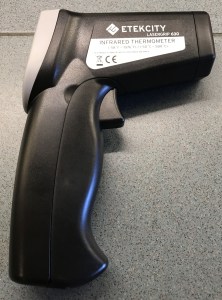
Not trusting this article, and not finding solace in the millions of “real-world” experiments about Newton’s Law of Cooling you can find in course websites (is the data really real?), I decided to conduct an experiment of my own. So I bought one of these.

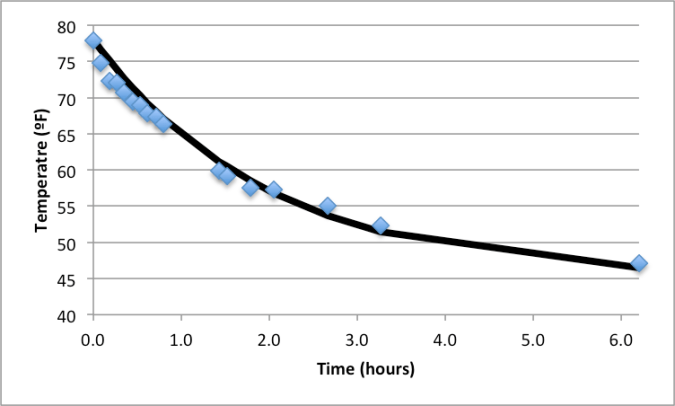
I took a bottle of white wine at 79ºF (which doesn’t bother me for everyday drinking wines because of these experiments) and put it in the fridge at 45ºF (yes, I know, have to do something about that). I measured the temperature at intervals over the next 6 hours. (Not regular intervals, because I have work to do.) The blue dots are the data points and the black line is the graph of the solution to Newton’s Law of Cooling, which says that the difference between the bottle temperature and the fridge temperature decreases by the same factor every hour. I used a factor of 0.6 (that is, the difference at the end of the hour is 0.6 what it was at the beginning), which seems to fit the data pretty well . No, I did not do a logarithmic regression, I just fiddled with the parameters in a graphing utility (damnit, Jim, I’m a mathematician, not a scientist!). (Or is that joke better the other way around?)

Temperature.png

Then I tried to make sense of the article.  Let’s say the fridge temperature was 35ºF. That extra half hour for white wine over red wine halved the difference between bottle and fridge from 20 to 10. So, in an hour, the temperature decreases by a factor of 0.25. This doesn’t agree with my 0.6, and it also doesn’t make sense, because it would suggest that the white wine was at a temperature of 675º when it was put in the fridge. And I couldn’t fix this by making different reasonable assumptions. After fooling around a bit, I found that all the numbers fit with my factor of 0.6 if you assume that the room temperature was 75ºF, the fridge temperature was 37ºF, the freezer temperature was 0ºF, and the 2.5 is a typo for 1.5.

So, a good rule of thumb is that the temperature difference halves every hour, plus a bit. This should also work for when you want a wine to warm up a little.


Breathing experiment no. 7: Does white wine breathe?

I was wondering this the other day, so I googled the question and found this article. I took the following quote as a challenge:

Gregg Wilson of The Artisan Cellar in Chicago said a “nice, fat, buttery” chardonnay will “definitely become more so” as it stands.

“You’ll lose some of the acidity, naturally, if a wine is open for a while but you will gain some tertiary flavors and aromas,” he said.

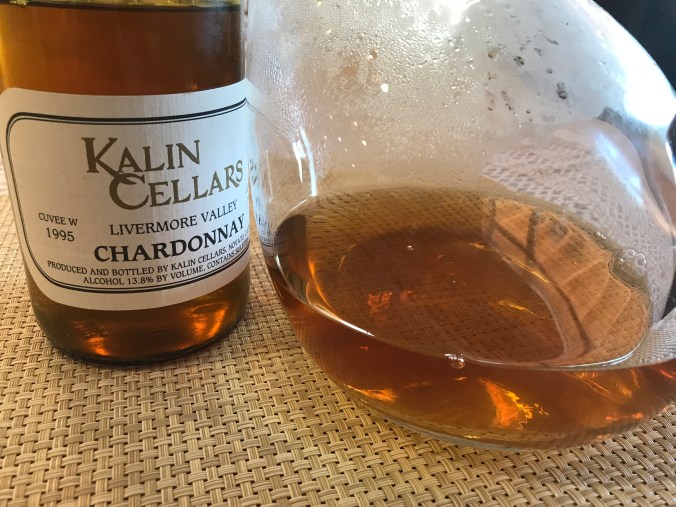
Lose some acidity? How is that possible? I mean, does a glass of Coke lose anything but bubbles over two hours? And HTF does a wine gain any tertiary anything in that time? OK, sorry, putting my science hat on now. I don’t have any fat buttery chardonnays, and if I did I wouldn’t want to make them fatter and butterier, but I do have this interesting 1995 Chardonnay from Kalin Cellars (which I bought for $36 in 2016; they don’t release the wines until they think they are ready, and although the wine is aged the price isn’t).

So Amy and I sat down to a Saturday lunch of prosciutto and melon and a nice aged California Chardonnay, and conducted a breathing experiment using the usual protocol (with 2.5 hours of breathing for the decanted wine). I guessed the configuration correctly, on the usual grounds: the wine straight from the bottle had a richer aroma and, in this case, a richer more honeyed palate. This experiment also confirmed a pattern I have noticed, which is that my very first impression after three quick sniffs, without tasting, is the best guide. There was not a lot of difference between the decanter and bottle; they were both delicious. My tasting note on this wine is here.

IMG_1406

What a lovely nut-brown honied color

Heat experiment no. 2: Shocking!

A couple of months ago I yanked a nice bottle of Chablis from its companions in my treehouse and placed it outside in the torturous conditions of an Arizona summer. Here are the temperature records for the two places:

Treehouse interior.png

Inside the treehouse

Treehouse exterior.png

Outside the treehouse

(If you are wondering about that dip inside the treehouse around May 27, that’s when we turned the treehouse into a temporary storage for all the produce and meat for Abby and Brendan’s wedding party.)

IMG_0437

I was going to leave it out all summer but after noticing the bulging cork I decided to have mercy. So Amy and I had a blind tasting experiment, using the same protocol as for my breathing experiments. We both easily identified the odd wine out. But I misidentified mine as the abused bottle. Here are my notes:

The middle one has a slightly dry acrid note, less fruit on the nose, more acid on the palate. Generally a lost of fruit and thinner, less interesting.

So I figured the middle one was the abused one. I was wrong. Of course, after the reveal, I started second guessing, and wrote the following notes (warning, this is no longer Science):

After experiment tried to find a flaw with the abused one. Maybe a slightly toasty funky note on the nose. Maybe a little flabby on the palate. Maybe a slightly sour milk note. And as I taste the wines more, I think the unabused wine has a little more spine and structure.

The abused wine is a little more viscous. More like yummy syrup than a complex structured juice.

This should all be taken with a grain of salt (oh no, yuk) given my prior expectation that heat would wreck a white Burgundy. I was thinking there would be some clear oxidation and discoloration. Maybe I should have left it all summer as originally planned. Tasting the abused wine again tonight (June 12), a day after the experiment, I agree with myself that it is o.k. but kind of nasty. I’m going to pour it down the drain just as soon as I have confirmation on that. Really I am.

The big takeaway is that this exposure to heat did not make the wine undrinkable. Although in this case the difference was much clearer than it was for my previous heat experiment.

Breathing experiment no. 6

You know the procedure by now. The wine was an aged cru bourgeois Bordeaux, which I chose in response to this tasting note:

Initially, the wonderful black fruit is completely dominated by oak, tannin, and acidity. It takes at least an hour in the decanter for the black fruit to start showing.

The decanted wine was aged for 3 hours. Everyone did very well:

Subject Order Notes
Jim ddb 3 decanter more alcohol
Housten bdd 1 bottle had not opened as much
Bill dbb 1 bottle richer aroma
Sally bdb 2 decanter decanted one has less aroma
Amy bdb 2 bottle less bright than the other two

Everybody correctly identified the odd wine out. Housten and Sally also correctly identified the source, although for opposite reasons. Sally chose 2 as the decanter because it had less aroma, Housten choice 1 as the bottle because it had not opened up as much.

I, it seems, agree with the tasting note that the decanted wine is fruitier. This doesn’t support my hypothesis that decanting the wine depletes the aroma, unless you invoke the masking theory proposed in this post.

[Added after posting] Amy’s note, however, agrees with the hypothesis, although she misidentified the source.

Breathing experiment no. 5

IMG_0338

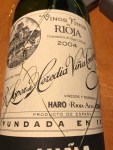
I love this label

For this experiment last night (May 29) I chose an older wine, a 2004 Rioja.  I was interested in whether we would witness the effect described in the 1999 article I mentioned in my previous post:

All four wines [1945 first growth Bordeaux] were dead. Letting them breathe had not improved them; it had killed them.

We followed the usual protocol, with the decanted wine receiving 6 hours of air. Here are our notes on the experiment:

Very difficult to tell. Middle aroma seems a bit richer, so I’m guessing dbd based on aroma.

On the palate very similar.

Amy is guessing 1 is the odd one out.

This time we were both right (Amy’s configuration was bdd), and we both used the aroma alone to make the choice. I’m intrigued by the following tasting note that appeared on CellarTracker this morning:

Classic Rioja with floral tinged red fruit and gorgeous cured tobacco. Fragrant, yet quite tightly wound. This needs hours and hours in the decanter to open things up and let the acidity calm down; it becomes soft and supple when it does. Lovely.

I didn’t notice any difference in the acids, but I have another bottle of this and might try again. Although I should admit up front that I do find it hard to believe that the acid-tannin composition changes much over a few hours. My tasting note on the wine is here. I agree the wine is “tightly wound,” and maybe did not give it enough attention to see past that.

Breathing experiment no. 4

As a reminder, I am working on the hypothesis that the main effect of allowing wine to breathe is a slight loss of complexity in the nose. I’ll relieve the suspense and say right now that this experiment confirmed the hypothesis (as did experiments nos. 2 and 3, at least as far as my own perceptions go).

This experiment was conducted 20 May 2017. I used a wine that is often said to benefit from air, a red burgundy.  The methodology was the same as experiment number 3. The wine breathed for 3.5 hours, whereas in previous experiments it has been more like 6. (I realize I should be recording these numbers.)

My three glasses had wine from the decanter, decanter, and bottle, respectively. Here are my notes (written before the reveal):

ddb at first because the right one seemed bit funky on the nose

second thoughts the middle seems slightly spicier, so maybe dbd

right one seems to have a fruitier palate
no difference in tannins or acids

left two more floral on the nose

going with first instinct

This result is consistent with my theory that breathing causes the nose to lose complexity, although in this case some might find the unmasked floral character of the decanted wine more appealing. It is also consistent with the observation that the effect is quite small; note the uncertainty and wavering.

By the way, my friend and colleague Phil Daro sent me a link to this blog post, which in turn has a link to this 1999 article from the New York Times. Reading them almost made me think I don’t need to bother with any more breathing experiments. They confirm my preconceptions. Except Science! Let’s go from preconceptions to statistical evidence. It will take a lot of breathing experiments to do that. The things I do for Science.

IMG_0324

Interesting addendum: my daughter wandered in about an hour after the bottle had been opened, and wanted to try the experiment. She identified the configuration correctly (dbd). Her reasons were entirely from the nose: she thought the middle wine had an aroma that was more mushroomy and gamey, whereas the other two she said were more metallic. Possibly my “funky” had evolved into her “mushroomy and gamey” in one hour. Maybe I need to do an experiment with multiple decanting periods.

Breathing experiment no. 3

IMG_0309This was my first breathing experiment using the Coravin, on May 4, 2017. The methodology is the same as before, except that it uses one bottle instead of two. I poured half the bottle into a decanter 6 hours in advance using the Coravin, and left the other half corked under its blanket of argon. I used a Barbaresco because of this tasting note on CellarTracker, which says that “Over an hour or so, pepper and astringent tannins on the palate overcame the fruit.” This suggests a different hypothesis from mine, that breathing causes the nose to lose complexity. Here the author describes a change in the palate.

The only experimental subjects were me and my wife. I rolled the die for her and she for me. Here are the results:

Person Configuration Choice Identification
A dbb 1 b
B ddb 3 b

We both chose the odd wine out correctly, and I correctly identified it as the wine from the bottle. I tried using both the nose and the palate: the third wine had a spicier more complex nose, so according to my original hypothesis it was the wine from the bottle. On the other hand, I fancied at first that the second wine had less fruit on the palate, which would have suggested a configuration of dbd. After a few sips I lost that difference so went with my first instinct. More evidence for my hypothesis.

But! My wife described the difference between her wines so:

No. 1 is different, sharper and more distinctive, with more acid, whereas the other two seem a little more soft.

This seems somewhat consistent with the tasting note on CellarTracker, in that it can be seen as describing a loss of fruit with breathing. Note that I described the same thing in my very first breathing experiment using this methodology. There, however, I also described the nose of the decanted wine as spicier and more aromatic. Which contradicts my hypothesis.

Obviously, more experimentation is necessary. I think I need to tighten up the descriptors a bit and apply them more consistently. For future experiments I will limit the descriptors to more complex/less complex for the nose and more (fruit, tannin, acid)/less (fruit, tannin, acid) for the palate.